
Back to all articles Article 19

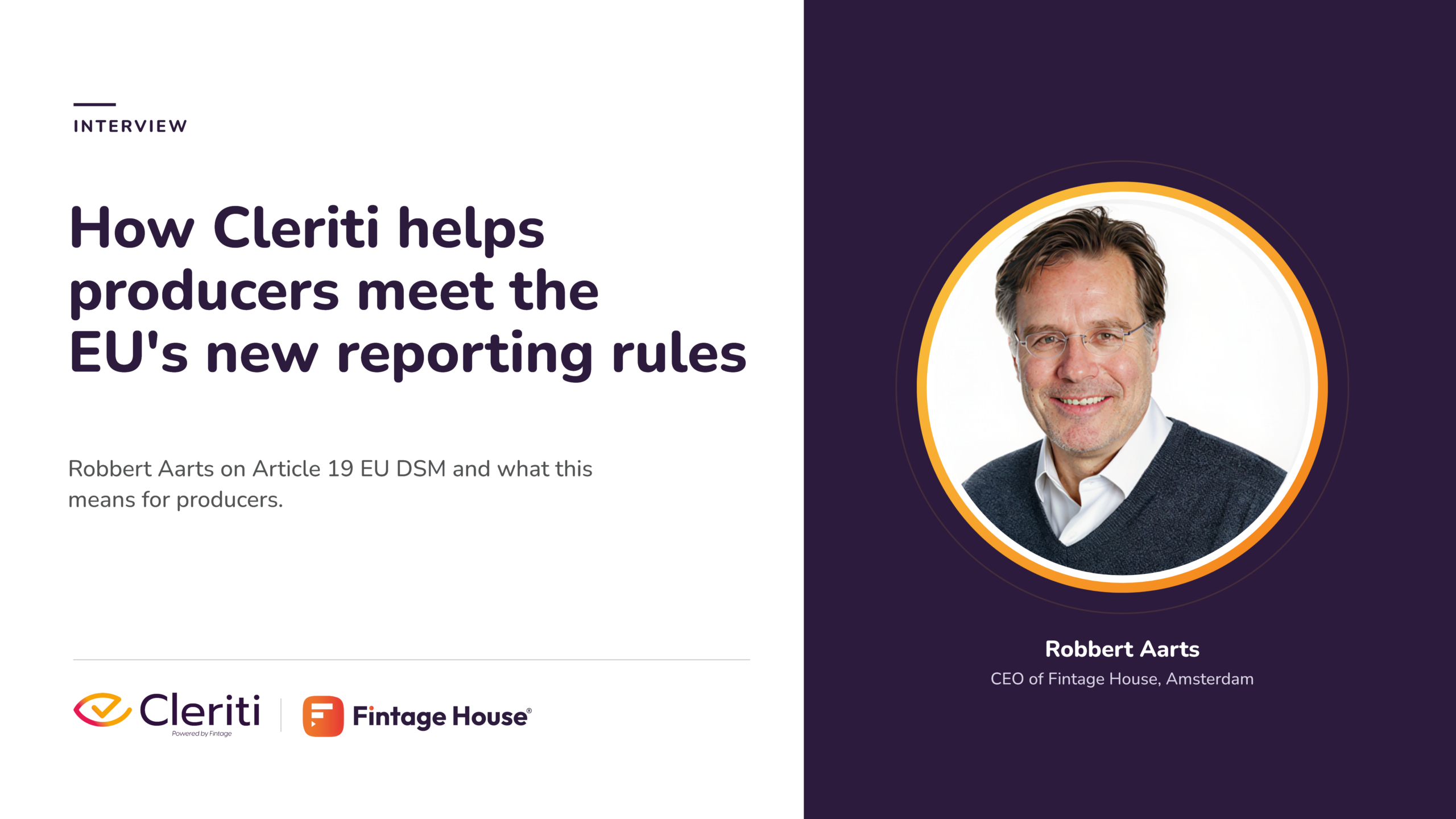
Robbert Aarts, CEO of Fintage House, on Cleriti and the EU’s transparency rules for producers.


Fintage House has worked with film and TV producers since 1993. Over those years, the company has seen the industry change, including the introduction of new transparency requirements under European copyright law.

Under Article 19 of the EU DSM authors and performers have the right to receive regular information about how their work is being used, the revenues generated, and the remuneration due. This brings new legal responsibilities for film and TV companies.

We spoke with Fintage House CEO Robbert Aarts about how he sees the new rules affecting producers, why Fintage co-founded Cleriti House and how Cleriti supports producers in complying with the transparency obligations.

Fintage House has worked alongside producers for many years. What made Cleriti the right service for you to support, and why now?

Cleriti fits well with what we do at Fintage House. We’ve worked with producers for many years, so we’re familiar with the challenges they face. When the EU introduced the new transparency rules, we realized producers would have another responsibility to manage, on top of everything else.

We liked the idea of developing an approach that really takes producers into account both how they work and the legal risks they face . This is what made us interested in co-founding Cleriti with our German legal partners.

Can you explain what this new EU obligation means for producers?

Well, the idea behind Article 19 of the EU DSM is to introduce transparency requirements for the audiovisual industry as the EU felt it was time to bring more fairness to the industry.

Producers now have to share information with authors and performers about the exploitation of their work, the revenues generated, and the remuneration due. The information has to be up to date and provided at least every year.

This means quite a mental shift from the usual way of doing business in film and TV. Commercial information that used to be confidential now has to be shared with creatives. And those same creatives may be entitled to request a contract adjustment under Article 20 if the original remuneration turns out to be disproportionately low compared to the revenues generated.

And then there’s the practical side of it. Producers now need to understand how the rules apply to them, what information they need to share, and how to organize the reporting. That’s not always easy especially when youré dealing with differences in national legislation.

How present is this topic in the industry right now?

The Transparency obligation has been discussed for some years now, often in connection with fair remuneration and contract adjustment rights of creatives. Producers and industry organisations have been discussing how to explain the legislation, how to comply in practice, while managing exposure and workload . What’s interesting is that although the EU Directive is the same, we see quite different approaches in countries because of local implementations.

Quite recently we’ve also seen that authors’ and performers’ organizations are taking a greater interest in how the rules are being followed. For example, earlier this year, a European study involving around two thousand actors looked at their experiences with transparency and fair remuneration.

As authors and performers become more aware of their rights, producers are starting to feel the need to act, if they haven’t done so already.

“As authors and performers become more aware of their rights, producers are starting to feel the need to act, if they haven't done so already.”

What actually happens to a producer who isn't compliant?

Good question. What happens depends on the national legislation, but the impact of non-compliance can go beyond legal consequences, such as possible fines. It can also affect the business itself.

For example, we have seen a producer who was trying to sell his company, along with the productions he had made. He ran into an issue: the company buying them said, “You’re not compliant.” The buyer then struggled to value what it was acquiring. So being compliant or not actually affects the value of the business itself.

Plus if you report, the creatives know what they need to know, and the statute of limitations starts. Otherwise, bestseller claims can go e.g. 10 years back.

How does Cleriti support producers?

One of the biggest difficulties for producers is that they have to comply with transparency obligations, but there is still no generally accepted industry standard for reporting.

Article 19 EU DSM sets out the obligation, but doesn’t explain exactly how producers should report. what information do they need to provide? How do the rules apply in their country?

Cleriti guides producers through these and other questions, starting with a review of the legal requirements for their productions. We then look at who needs to receive the reports, what information is available and any other reporting needs. Together we establish what needs to be reported, how much detail is required and how reporting can be organised.

The Cleriti platform helps producers put this approach into practice and manage their reports. And because transparency reporting is an ongoing obligation, Cleriti continues to provide support as new questions arise. In that sense, we believe we contribute in shaping generally accepted industry standard for reporting.

What makes Cleriti's approach different, and how does it help producers stay ahead of these obligations?

In my opinion, it’s the experience behind Cleriti. The team includes leading copyright lawyers who have been working on transparency obligations even before Article 19 was introduced. And the Fintage people who have worked in the film and TV industry for decades.

That combination is important. We understand both the legal side and how producers actually work.

This is exactly how Cleriti’s compliance methodology was developed. We put legal guidance first, and the platform supports producers to apply that guidance into practice while keeping control over their reporting.

Is there anything else you think is important for producers to consider?

I think it’s worth looking at transparency reporting not just as another legal requirement, but as something that can benefit producers and the way they run their business.

Having proper reporting records can be valuable when selling a film library or a company. And transparent communication with authors and performers builds trust and can help maintain good relationships.

And there’s another important point. As mentioned before, there is no established industry standard for reporting yet. So producers who are already reporting are, in a way, shaping the practical standards of transparency reporting.

I believe that is a real opportunity. Because if producers don’t get involved now, they may end up having to follow standards that others have set for them.

Finally, what would you say to producers who are still waiting to act?

I would say that the law is already in place, and producers are expected to comply with it sooner or later. As setting up proper reporting takes time I think it makes sense to start early.

I understand why some producers are hesitant. There’s still a lot of uncertainty around how the legal requirements should be interpreted and applied in practice.

But that doesn’t mean you can’t get started. With the right guidance, producers can take a first step, keep reporting proportionate and under control , and be better prepared for the future.

Also, there may be producers out there concerned about opening Pandora’s box: “Will I be hit by a multitude of contract adjustment claims if I report?”. From our experience with our clients reporting, we can confirm that such is not true at all. On the contrary – reporting has built trust.

Tags: Article 19 EU DSM Directive Producers
Written by Maria Khizhniakova & Cleriti Legal Team